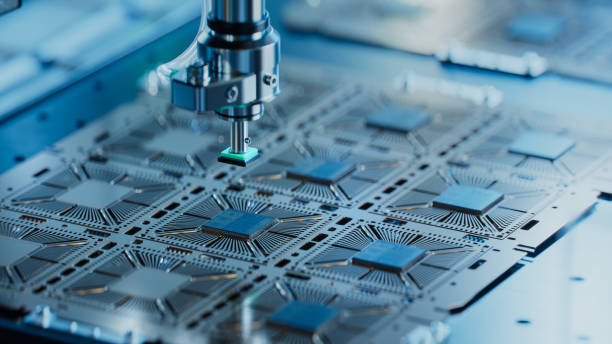
China’s electronics industry has developed into one of the world’s most important manufacturing and sourcing ecosystems. From basic components and power devices to integrated circuits and programmable logic, the country supports a wide range of industries, including consumer electronics, automotive systems, industrial automation, telecommunications, data centers, and smart devices.
For international buyers, however, China’s value is no longer limited to large-scale manufacturing. The market is becoming increasingly focused on semiconductor development, local supply chains, engineering support, and specialized components. At the same time, growing demand for artificial intelligence, industrial automation, and high-performance computing is creating new opportunities for programmable technologies such as field-programmable gate arrays (FPGAs).
Understanding both the supplier landscape and FPGA market trends can help OEMs, engineers, and procurement teams make better sourcing decisions.
Why Is China Important to the Global Electronics Supply Chain?
China’s electronics ecosystem combines component manufacturing, semiconductor design, PCB production, assembly, testing, packaging, and international logistics within a highly developed industrial network.
This creates an important advantage for buyers. Instead of sourcing every stage of a project from a completely separate region, companies can often find multiple parts of their supply chain within China’s major electronics clusters.
Shenzhen and the wider Guangdong region remain particularly important for electronic components, semiconductor sourcing, PCB manufacturing, and electronics assembly. Shanghai and Beijing have strong semiconductor design and technology ecosystems, while Jiangsu has developed capabilities in semiconductor packaging and precision electronics.
This concentration of expertise allows buyers to source products ranging from relatively simple discrete components to more sophisticated semiconductor solutions.
What Types of Electronic Component Suppliers Operate in China?
The Chinese market includes several different supplier models, and understanding the difference between them is important.
Manufacturers typically focus on producing particular product categories, while distributors may offer components from multiple brands. Other companies provide engineering, replacement, testing, or sourcing services alongside component supply.
Common product categories include:
- Diodes and transistors
- MOSFETs and power devices
- Integrated circuits
- Power management ICs
- Connectors and cable assemblies
- Sensors
- Passive components
- Display modules
- Memory products
- Programmable logic devices
- PCB and electronic assembly components
When comparing electronic component companies in China, buyers should therefore look beyond company size or unit price. Product specialization, manufacturing capabilities, technical support, quality systems, replacement options, and supply reliability can be equally important.
The right supplier for a prototype project may not necessarily be the best supplier for continuous high-volume production.
How Should Global Buyers Evaluate Chinese Component Suppliers?
Finding a supplier online is relatively easy. Verifying whether that supplier is appropriate for a specific project requires more work.
A practical supplier evaluation should begin with the product itself.
Buyers should confirm:
Part Specification → Manufacturer Capability → Quality Control → Technical Support → Production Capacity → Lead Time → Logistics
For semiconductor components, technical compatibility is particularly important. A replacement component may look similar on paper but still differ in electrical characteristics, package dimensions, thermal behavior, or application performance.
This is why engineering support can add considerable value when sourcing alternatives for obsolete, expensive, or difficult-to-find components.
China Chip Depot, for example, focuses on semiconductor and electronic component manufacturing for OEM, ODM, and industrial buyers, including diodes, transistors, MOSFETs, PMICs, and component replacement support.
Why Are FPGAs Important in Modern Electronics?
An FPGA, or field-programmable gate array, is a semiconductor device that can be configured after manufacturing to perform specific digital functions.
This flexibility distinguishes FPGAs from fixed-function chips. Engineers can program and reconfigure FPGA logic for a particular application without developing an entirely new custom chip.
That makes FPGA technology valuable in applications where flexibility, parallel processing, low latency, or specialized hardware acceleration is required.
Typical applications include:
- Industrial automation
- Telecommunications
- Data processing
- Automotive electronics
- Test and measurement equipment
- Video and image processing
- Aerospace systems
- Embedded computing
- Edge computing
- Artificial intelligence acceleration
FPGAs can also provide an intermediate option between general-purpose processors and custom ASIC development.
Who Are the Leading FPGA Manufacturers?
The global FPGA market has traditionally been led by a relatively small number of established semiconductor companies.
AMD’s Xilinx portfolio and Altera are major names in programmable logic, while Lattice Semiconductor and Microchip Technology serve important segments of the market as well. Different manufacturers focus on different combinations of performance, power consumption, device size, cost, software ecosystems, and target applications.
Buyers comparing leading FPGA manufacturers should therefore avoid choosing solely on brand recognition.
The correct FPGA depends on the project.
A high-performance data-processing system may prioritize logic density and high-speed interfaces, while a portable embedded device may place greater emphasis on low power consumption. Industrial applications may prioritize long product lifecycles, reliability, and stable availability.
Development tools and engineering ecosystems should also be considered because hardware is only one part of an FPGA project.
What Is Driving FPGA Demand in China?
Several technology trends are supporting demand for programmable logic.
Artificial intelligence is one important factor. Although GPUs and custom AI accelerators receive much of the attention, FPGAs remain useful where workloads benefit from reconfigurable hardware, deterministic processing, or specialized low-latency acceleration.
Industrial automation is another important market. Smart factories require increasingly sophisticated control, machine vision, communications, and real-time data processing.
China’s continued investment in data infrastructure and semiconductor localization is also encouraging domestic development across multiple chip categories.
As these markets expand, FPGA suppliers are competing not only on hardware performance but also on software tools, IP libraries, development support, and application-specific solutions.
Are Chinese FPGA Manufacturers Becoming More Competitive?
China’s domestic FPGA ecosystem has continued to develop, particularly as the country places greater emphasis on semiconductor localization.
Domestic companies are targeting areas ranging from industrial control and embedded applications to communications, automotive electronics, and higher-performance computing.
However, FPGA competition is technically demanding. Developing the silicon itself is only part of the challenge. Successful vendors also need reliable design software, reusable IP, documentation, technical support, and an ecosystem that allows engineers to move from design to production efficiently.
This means global and domestic manufacturers may continue to compete differently across market segments.
For buyers, the growing number of options can be beneficial, but new devices should be evaluated carefully for performance, development-tool maturity, supply continuity, and application compatibility.
How Are AI and Edge Computing Changing Component Demand?
The rise of AI is influencing much more than processors.
AI servers, edge devices, industrial vision systems, and intelligent machines require power-management components, memory, sensors, communications devices, discrete semiconductors, and advanced logic.
Edge computing is particularly interesting because it moves more processing closer to where data is generated. Instead of sending every piece of information to a distant cloud platform, a factory machine, camera, vehicle, or industrial device can process some information locally.
This creates demand for components capable of balancing performance, power consumption, connectivity, and real-time processing.
FPGAs can fit into this environment because their hardware can be optimized for specific workloads and later reconfigured as requirements change.
What Should Buyers Consider When Sourcing FPGAs and Components?
Procurement teams should avoid treating semiconductor sourcing as a simple price comparison.
For standard electronic components, buyers should consider authenticity, specifications, production consistency, lead times, and supplier support.
For FPGAs, additional factors become important:
Performance → Logic Resources → Power → I/O → Software Tools → IP Support → Availability → Lifecycle
Supply continuity also deserves attention. Changing an FPGA after a product has entered production may require hardware redesign, firmware changes, new testing, and certification work.
For this reason, engineering and procurement teams should work together when evaluating critical semiconductor components.
What Does the Future Look Like for China’s Electronics Industry?
China’s electronics industry is moving toward a combination of large-scale manufacturing and greater technological specialization.
Traditional strengths such as dense supplier networks and manufacturing capacity remain important, but semiconductor localization, AI infrastructure, advanced packaging, industrial automation, and domestic chip development are increasingly shaping the market.
For international buyers, this creates both opportunities and responsibilities. There are more sourcing choices, but technical verification and supplier evaluation become increasingly important as products become more specialized.
The FPGA market reflects this broader transition. Established international manufacturers remain influential, while domestic suppliers continue developing alternatives for different application segments.
Final Thoughts
China’s electronics industry remains a critical part of the global technology supply chain, but the market is evolving beyond its traditional manufacturing role.
Electronic component buyers now have access to a broad ecosystem covering discrete semiconductors, power devices, ICs, connectors, displays, programmable logic, and engineering support. At the same time, demand from AI, industrial automation, communications, and edge computing is increasing the importance of advanced semiconductor technologies such as FPGAs.
For OEMs and procurement teams, successful sourcing starts with clearly defined technical requirements. Supplier capability, component compatibility, quality control, development support, lifecycle availability, and logistics should all be evaluated alongside price.
As China’s semiconductor ecosystem continues to develop, businesses that combine careful supplier selection with strong technical evaluation will be better positioned to benefit from the country’s expanding electronics and programmable-logic market.